Wednesday, April 16, 2014


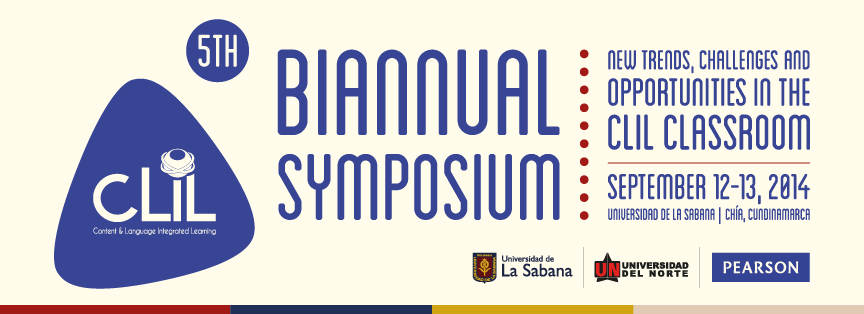
5th Biannual CLIL Symposium

“New Trends, Challenges and Opportunities
in the CLIL Classroom”

The Universidad de La Sabana, the Universidad del Norte, and Pearson Colombia would like to invite you to attend the 5th Biannual CLIL Symposium, to be held at the Universidad de La Sabana campus in Chía, Colombia on 12-13 September 2014.

This year’s symposium will focus on new trends, challenges, and opportunities in the CLIL classroom, including issues in the integration of information and communication technologies and the debate on how to incorporate culture and interculturality.

We are very fortunate to have experienced keynote speakers in the field of CLIL from the UK, Canada, Argentina, and the USA confirmed thus far; Dr. Do Coyle, Dr. Nina Spada, Dr. Dario Banegas and Dr. Gisella Langé. We are, as ever, committed to bringing the latest CLIL knowledge and trends to the people who require it most—the teachers in schools, language institutes, and universities across the country.

In addition to attending the 2-day Symposium, you will also have the opportunity to participate in preconference sessions with keynote speakers.  Furthermore, for the first time, a volume of proceedings from this year’s CLIL Symposium will be published by the Universidad de La Sabana in the months following the event.

We look forward to your participation in the 2014 Biannual CLIL Symposium. Please find below more information on prices, dates, and how to register. We are looking forward to seeing you there! If you have any questions, please do not hesitate to contact us via the email address clilsymposium@unisabana.edu.co.

Sincerely,


The 2014 CLIL Symposium Committee

Wednesday, November 27, 2013

Call for papers April 2014 Issue

Call for papers April 2014 Issue 

Dear Colleague,

This is to inform you that we are receiving papers for the April 2013 issue of the Latin American Journal of Content & Language Integrated Learning (LACLIL), a biannual publication led by Universidad de La Sabana’s Department of Foreign Languages and Culture.

You are encouraged to distribute this call for papers to your professional colleagues and contacts. Visit LACLIL at www.laclil.unisabana.edu.co to register as a reader, reviewer, and/or author and to submit your work. Issues are published twice a year, in April and October. All published materially is freely accessible.


The relationship between language proficiency and Iranian EFL learners' knowledge of vocabulary depth versus vocabulary breadth | Tahmasebi | Latin American Journal of Content & Language Integrated Learning

The relationship between language proficiency and Iranian EFL learners' knowledge of vocabulary depth versus vocabulary breadth | Tahmasebi | Latin American Journal of Content & Language Integrated Learning:

Click here for complete article 

'via Blog this'

An EAP curriculum design of a content and language integrated learning program for hospitality students in Taiwan | Hou | Latin American Journal of Content & Language Integrated Learning

An EAP curriculum design of a content and language integrated learning program for hospitality students in Taiwan | Hou | Latin American Journal of Content & Language Integrated Learning:

Click here for complete article 

'via Blog this'

Developing academic register in CLIL: UK-based Spanish L2 students’ Latin America Political Economy writing in the UK | Hughes | Latin American Journal of Content & Language Integrated Learning

Developing academic register in CLIL: UK-based Spanish L2 students’ Latin America Political Economy writing in the UK | Hughes | Latin American Journal of Content & Language Integrated Learning:

Click here for complete article 

'via Blog this'

Editorial introduction | McDougald | Latin American Journal of Content & Language Integrated Learning

Editorial introduction | McDougald | Latin American Journal of Content & Language Integrated Learning:

Click here for comeplete Editorial 

'via Blog this'

The use of the L1 in CLIL classes: The teachers’ perspective | Lasagabaster | Latin American Journal of Content & Language Integrated Learning

The use of the L1 in CLIL classes: The teachers’ perspective | Lasagabaster | Latin American Journal of Content & Language Integrated Learning:

Click here for complete article

'via Blog this'

New LACLIL issue: Vol. 6, Issue 2 (2013)

LACLIL VOL. 6 NO. 2 (2013)
Readers:

It is with great pleasure that I welcome you to a new issue of the Latin American Journal of Content and Language Integrated Learning (LACLIL), available at http://laclil.unisabana.edu.co/, offering insights on the theory and practice of CLIL-based and related approaches from practitioners and researchers in Latin America and around the world.

We invite you to review the Table of Contents in this message and to visit the journal's Web site to read and download the freely-available, open-access research articles there.

Thanks for your continuing interest, and we look forward to your participation!

Sincerely,
Dr. Carl Edlund Anderson
Editor-in-Chief, LACLIL


Latin American Journal of Content & Language Integrated Learning Vol 6, No 2 (2013) 
Table of Contents

--------
Journal information (i-ii)
            Carl Edlund Anderson

Editorial introduction (iii-v)
            Jermaine S. McDougald


Articles
--------
The use of the L1 in CLIL classes: The teachers’ perspective (1-21)
            David Lasagabaster

The receptive vocabulary of Spanish 6th-grade primary-school students in CLIL instruction: A preliminary study (22-41)
            Andrés Canga Alonso

Developing academic register in CLIL: UK-based Spanish L2 students’ Latin America Political Economy writing in the UK (42-71)
            Neil Hughes

An EAP curriculum design of a content and language integrated learning program for hospitality students in Taiwan (72-95)
            Hsiao-I Hou

The relationship between language proficiency and Iranian EFL learners'
knowledge of vocabulary depth versus vocabulary breadth (96-111)
            Gholam-Ali Tahmasebi,     Hamidreza Haghverdi,       Mehdi Ghaedrahmat


Latin American Journal of Content and Language Integrated Learning http://laclil.unisabana.edu.co/


Saturday, May 25, 2013

Call for Papers October 2013 Issue

Call for Papers October 2013 Issue
Dear Colleague,

This is to inform you that we are receiving papers for the October  2013 issue of the Latin American Journal of Content & language Integrated Learning (LACLIL), a biannual publication led by Universidad de La Sabana’s Department of Foreign Languages and Culture.

You are encouraged to distribute this call for papers to your professional colleagues and contacts. Visit LACLIL at www.laclil.unisabana.edu.co to register as a reader, reviewer, and/or author and to submit your work. Issues are published twice a year, in April and October. All published materially is freely accessible.


Kind Regards,


LACLIL EDITORIAL STAFF

Monday, April 15, 2013

New LACLIL issue: Vol. 6, Issue 1 (2013)

We are pleased to announce publication of the April 2013 issue of the Latin American Journal of Content and Language Integrated Learning (LACLIL): http://laclil.unisabana.edu.co/index.php/LACLIL/issue/current. You are cordially invited to visit the journal’s Web site, where you will find the new issue’s table of contents, with links to articles and other items of interest.

The April 2013 issue of LACLIL issue features articles devoted to teaching adults through Situated Learning in an EFL classroom and to using SIOP for project-based learning in a content-language classroom. There is also an article which will be of interest to those working on issues of motivation and demotivation, along with an interesting piece on using comic strips to teach history and a review of a book on CLIL activities.

The Editorial Board is also pleased to announce that all articles published in LACLIL now receive a DOI. A DOI is a permanent unique international identification code, the digital object identifier (DOI), which is registered with the international DOI Foundation (www.doi.org) and CrossRef (www.crossref.org, a not-for-profit organization that manages DOIs as a reference linking standard, enabling cross-publisher linking, and that maintains the lookup system for DOIs). LACLIL is a member of CrossRef. Article DOIs never change and make it easier for authors’ work to be identified and for readers to cite articles accurately.


We would like to remind you that we are currently accepting submissions for our October 2013 issue and future issues. We would also like to invite readers interested in participating as peer reviewers on the journal's Scientific Board to update their profiles on the journal's Web site appropriately.

You are encouraged to distribute this announcement to your colleagues and contacts.

Thanks for your continuing interest in our work,
Editorial Board
Latin American Journal of Content and Language Integrated Learning

Thursday, January 17, 2013

Call for Papers April 2013 Issue


Call for papers April 2013 ISSUE
Dear Colleague,

This is to inform you that we are receiving papers for the April 2013 issue of the Latin American Journal of Content & language Integrated Learning (LACLIL), a biannual publication led by Universidad de La Sabana’s Department of Foreign Languages and Culture.

You are encouraged to distribute this call for papers to your professional colleagues and contacts. Visit LACLIL at www.laclil.unisabana.edu.co to register as a reader, reviewer, and/or author and to submit your work. Issues are published twice a year, in April and October. All published materially is freely accessible.


Thursday, December 20, 2012

LACLIL Call for Papers April 2013 Edition


Call for papers April 2013 Edition
Dear Colleague,

This is to inform you that we are receiving papers for the April 2013 issue of the Latin American Journal of Content & language Integrated Learning (LACLIL), a biannual publication led by Universidad de La Sabana’s Department of Languages and Culture.

The Latin American Journal of Content and Language Integrated Learning (LACLIL) is a peer-reviewed, open-access journal focused on CLIL (Content and Language Integrated Learning), multilingualism, interculturalism, and CALL (computer-assisted language learning), throughout Latin America and around the world aimed at teachers, researchers, & educational administrators who are interested in researching, implementing, or improving language-learning approaches, techniques, materials, and policies.
LACLIL is currently open for article submissions from researchers whose work is related to instructional practices implemented in language-learning subjects or subjects taught through an additional language as well as ICT and cultural issues related to language learning. Articles, commentaries or teaching articles and reviews on (but not limited to) the following areas are welcomed:
§  Educational approaches in which additional languages are used for the learning and teaching of both content and language (CLIL).
§  Language learning, teaching, and/or evaluation practices aimed at fostering cognition and metacognition though language or content.
§  The use of Information and Communication Technologies  (ICT) to foster communicative competences enhancing cognition, metacognition, and the learning of language, content, or both.
§  CLIL methodology, assessment and/or evaluation
§  CLIL curriculum design
§  The learning of culture and/or intercultural competences in or through additional languages.
§  Teacher professional development initiatives in the aforementioned areas.


Visit LACLIL’s Web site at www.laclil.unisabana.edu.co register as a reader, reviewer, and/or author and to submit your work. Issues are published twice a year, in April and October. If further assistance is required please contact the Editorial Staff at laclil@unisabana.edu.co for further information. All articles published by LACLIL are made available under an open access license.
You are encouraged to distribute this call for papers to your professional colleagues and contacts. Visit LACLIL’s Web site at www.laclil.unisabana.edu.co to register as a reader, reviewer, and/or author and to submit your work. Issues are published twice a year, in April and October. All published materially is freely accessible.

Wednesday, November 21, 2012

New Official URL for LACLIL

We are pleased to announce that the Latin American Journal of Content & Language Integrated Learning now has a new official URL: http://laclil.unisabana.edu.co/index.php/LACLIL. Redirection from earlier URLs will continue to function for the forseeable future.

For the best results, we encourage your use to the new URL, http://laclil.unisabana.edu.co/index.php/LACLIL, in all links and other references to the journal's Web site.

Wednesday, October 31, 2012

Editorial for Vol 5, Issue 2 October 2012


Editorial introduction: A reflection on the role of foreign language learning in today’s education
 

Rigoberto Castillo
Universidad Distrital Francisco José de Caldas
(Bogotá, Colombia)

Introduction

As a guest editor of this edition of the Latin American Journal of Content and Language Integrated Learning (LACLIL), I would like to share with the readers a reflection on what I perceive as the evolving role of foreign language (FL) learning in today’s educational settings. I offer some ideas on what institutions need to consider in FL teaching and propose some questions for these to think about.
Many people are in contact with other languages in mass communication as well as in private communication. Education, research, entertainment, edutainment, news, and social networks, Web sites and platforms—to name a few—pervade work and home routines. These serve the most diverse audiences and purposes. On the other hand, academic and professional mobility has become the norm. People work in networks; they are connected by interests, often independently of nationality, culture, or language.
Today the study of an FL may provide people with opportunities to interact with other cultures and to gain awareness on a global citizenship. Information technologies have facilitated the purposeful or the incidental contact with world communities; these factors have transformed the way we learn, we teach, and we interact with others. Along those lines, I see that FL education allows access to global knowledge. In addition to promoting communication and culture, it serves as an instrument for disseminating the knowledge generated locally. Thus, connections with other communities become of utmost importance.

How Can educational institutions adapt to the new roles of FL study?

In the last decade, FL learning and use has evolved in its purposes, in its genres, in its means, and in its substance. Business transactions, academic communication, social interactions, and everyday routines (for just some examples) tend to be diverse, multilingual, and multicultural. The educational system has been challenged to prepare people to use a FL for communication as opposed to as a subject of study.
The challenge to adapt to the new roles of FL learning and use covers funding, large-scale program development, syllabus design, methodology, implementation of ICT, testing, assessment, and evaluation (see Ruane, 2003). In addition, the educational sector has been required to not only start FL education earlier, but to be held accountable for faster, better, and more tangible results in FL proficiency. In this panorama, I feel institutions would need to offer:
·        practical language training especially for learners not specializing in languages,
·        the use and development of appropriate technology for language learning,
·        research and development in the field of language teaching and learning,
·        contribution of FL study to international academic communication with the consolidation of programs that promote scholarship and divulgation of institutional projects, achievements, publications and research,
·        an agenda with the libraries and the resource centers to promote access to academic databases and to reliable sources of information since the FL is so important in this endeavor,
·        constitution of language programs that meet the demand for high standards,
·        offer activities to promote the arts from diverse cultures
Along the lines of assuming new roles, I would like to argue for the specificity of FL teaching. The instruction received in classrooms may lag behind the education received in the environment. Meeting the present and the future needs of learners requires a revision of syllabi and of classroom practices. Learners need exposure to, and study of, the genres they encounter daily and those genres they encounter in disciplines of study. Genres such as reviews of books, movies, television shows, as well as scientific reports and specialized lectures, would add meaning and usefulness to FL study.
Hyland (2002) argues that “effective language teaching involves taking specificity seriously. It means that we must go as far as we can” (p. 394).For teachers, this means introducing learners to the relevant genres with the purpose of allowing them to participate in a discourse community organized around specific and purposeful activities. This can be approached in pragmatic or critical ways, and there has been a considerable amount of discussion about the need to avoid uncritical induction of students into disciplinary discourses and identities (Canagarajah, 2002; Harwood & Hadley, 2004; Pennycook, 1997 ).
In closing I would like to pose some of the questions that academic institutions need to ask themselves:
·        How can language programs propose ways to address the teaching of the FL as meaningful and useful to their learners and to their institution?
·        How can institutions propose internal and external assessment and evaluation that are coherent with the FL programs?
·        How can new spaces be created to stimulate learner’s agency and autonomy in FL learning?
·        How can FL study better relate to the agenda of internationalization of education?

References

Canagarajah, A. S. (2002). Critical academic writing and multilingual students. Ann Arbor, MI: University of Michigan Press.
Harrabi, A. (2009) Education in English for Specific Purposes in Tunisia: The case of the Higher Institute of Commerce of Sousse. ESP World, 27. Retrieved from http://www.esp-world.info/articles_27/abdelfatteh.pdf
Harwood, N., & Hadley, G. (2004). Demystifying institutional practices: critical pragmatism and the teaching of academic writing. English for Specific Purposes, 23(4), 355–377. doi:10.1016/j.esp.2003.08.001
Hyland, K. (2002). Specificity revisited: How far should we go now? English for Specific Purposes, 21(4), 385–395. doi:10.1016/S0889-4906(01)00028-X
Pennycook, A. (1997). Cultural alternatives and autonomy. In P. Benson & P. Voller (Eds.). Autonomy and independence in language learning (pp. 35-53). Harlow, England: Longman.
Ruane, M. (2003). Language centres in higher education: Facing the challenge, ASp, 41-42, 5-20. doi:10.4000/asp.1127

Biodata

Rigoberto Castillo, Ph.D., teaches in the College of Education at the Universidad Distrital Francisco José de Caldas in Bogotá, Colombia.

New Issue of LACLIL Published October 2012

Readers,

Latin American Journal of Content & Language Integrated Learning has just published its latest issue at http://www.laclil.edu.co/. We invite you to review read the Editorial Introduction by Dr. Rigoberto Castillo as well as the Table of Contents here, then visit our Web site to review articles and items of interest.

The editorial staff is also pleased to announce that all articles published in LACLIL will receive a DOI. A DOI is a permanent unique international identification code, the digital object identifier (DOI), which is registered with the international DOI Foundation (http://www.doi.org/) and CrossRef (http://www.crossref.org/) another not-for-profit organization, which manages the DOI as a reference linking standard, enabling cross-publisher linking, and maintains the look-up system for DOIs. LACLIL is a member of CrossRef.

We recommend that you include the DOI when citing material published online in LACLIL. Furthermore the DOI forms part of the article’s URL (Web
Address) and can be used to access the article. The DOI will never change and will make it easier for authors to be identified and for readers to cite. Past articles have also been assigned DOIs organized as such:
doi:10.524/laclil.2008.1.1.29 (Please note that, as of now, DOIs retroactively assigned to past articles may not yet be reflected in the published PDFs.)

Thanks for your continuing interest in our work,

LACLIL EDITORIAL STAFF